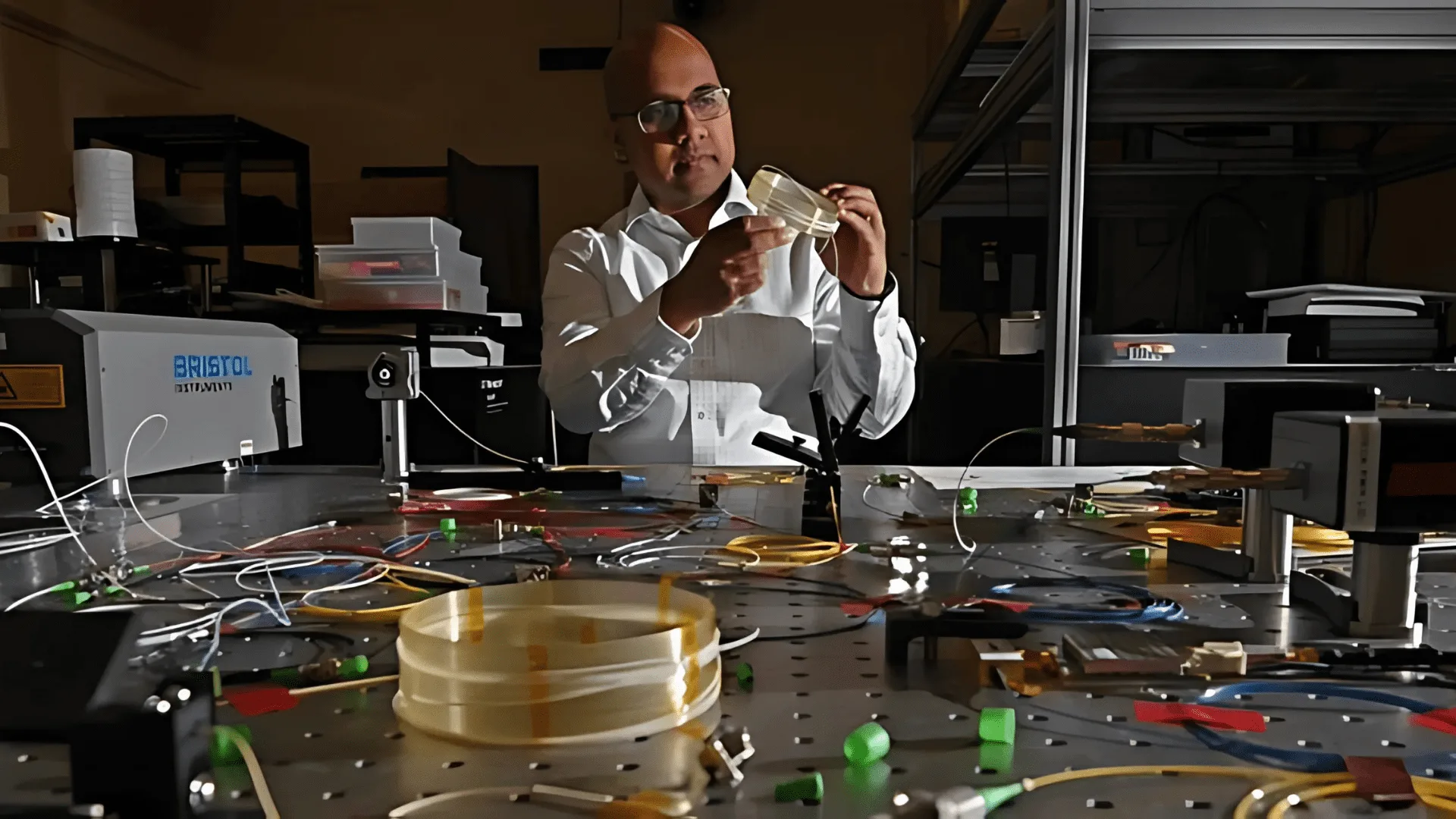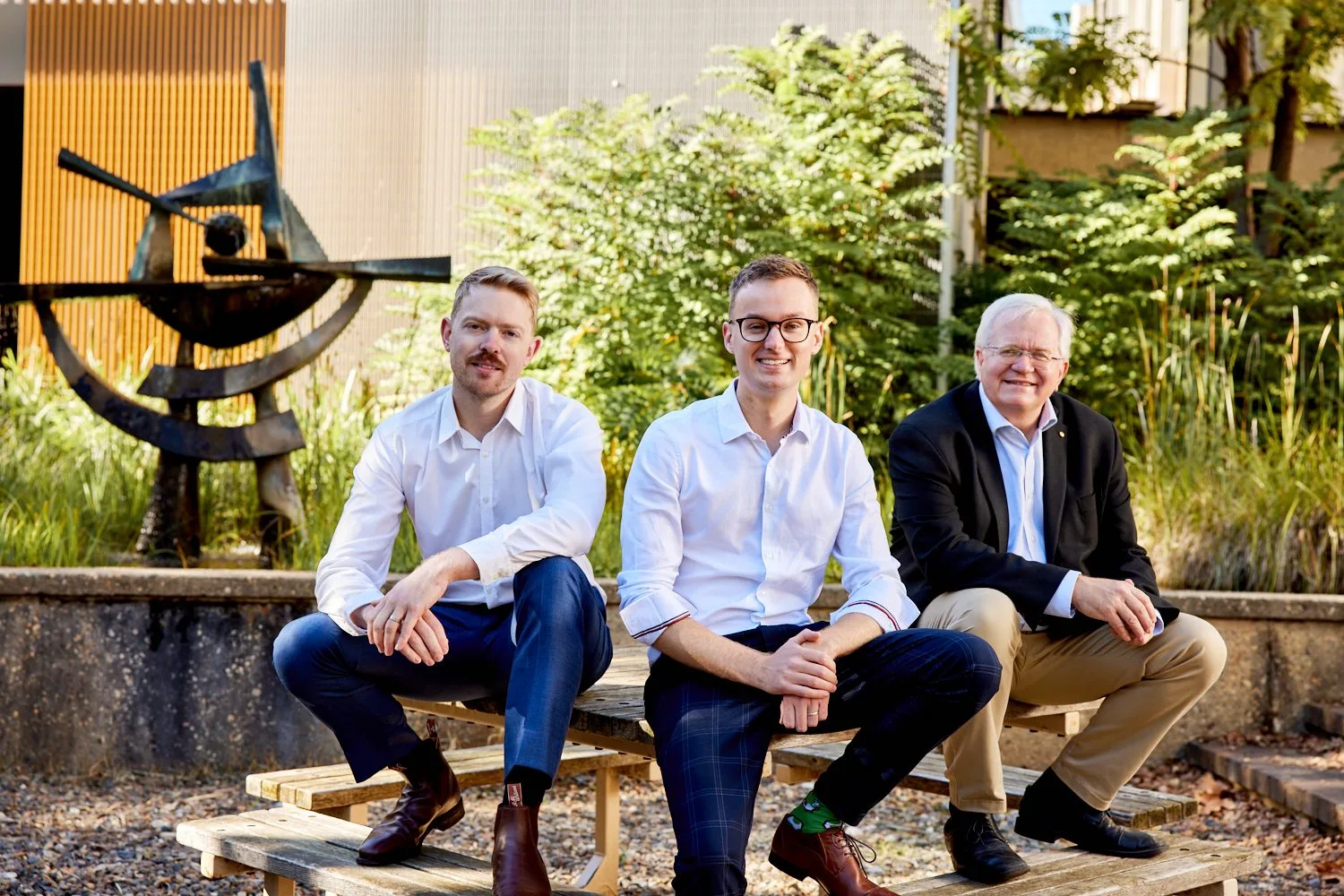
Australian researchers shape the future of photonic sensing with spin-off company Vai Photonics

In 2021, Australian researchers Lyle Roberts and James Spollard, from The Australian National University (ANU), co-founded Vai Photonics: a spin-off company developing patented photonic sensors for precision navigation. The ARC Centres of Excellence for Engineered Quantum Systems (EQUS) and Gravitational Wave Discovery (OzGrav) played key roles in kickstarting Vai Photonics by providing seed funding towards fundamental LiDAR research, which translated to real-world, industry applications. Now, Advanced Navigation, one of the world’s most ambitious innovators in AI robotics and navigation technology, has announced the acquisition of Vai Photonics with aims to commercialise Roberts and Spollard’s research into exciting autonomous and robotic applications across land, air, sea and space.

“The technology Vai Photonics is developing will be of huge importance to the emerging autonomy revolution. The synergies, shared vision and collaborative potential we see between Vai Photonics and Advanced Navigation will enable us to be at the absolute forefront of robotic and autonomy-driven technologies,” said Xavier Orr, CEO and co-founder of Advanced Navigation.

Vai Photonics co-founder James Spollard explained: “Precision navigation when GPS is unavailable or unreliable is a major challenge in the development of autonomous systems. Our emerging photonic sensing technology will enable positioning and navigation that is orders of magnitude more stable and precise than existing solutions in these environments.

“By combining laser interferometry and electro-optics with advanced signal processing algorithms and real-time software, we can measure how fast a vehicle is moving in three dimensions,” said Spollard. “As a result, we can accurately measure how the vehicle is moving through the environment, and from this infer where the vehicle is located with great precision.”

The technology, which has been in development for over 15 years at ANU, will solve complex autonomy challenges across aerospace, automotive, weather and space exploration, as well as railways and logistics.

EQUS Director Professor Andrew White applauded the initiative and determination shown by Lyle and James. “Lyle and James are perfect examples of researchers achieving useful outcomes by utilising the funds, mentoring, and guidance available through EQUS’s Translation Research Program, to help pursue the real-world impacts that our research can deliver. These two are what Australia’s research future looks like,” said White.
​
OzGrav Director Professor Matthew Bailes said he was thrilled to see such a positive outcome for our early career researchers that were supported by OzGrav’s industry seeding scheme and workshops. “It reinforces the fact that pushing the limits of instrumentation for scientific purposes can often create opportunities for Australian innovators and industry,” said Bailes.
​

​Professor Brian Schmidt, Vice-Chancellor of the Australian National University said: “Vai Photonics is another great ANU example of how you take fundamental research – the type of thinking that pushes the boundaries of what we know – and turn it into products and technologies that power our lives.
“The work that underpins Vai Photonics’ advanced autonomous navigation systems stems from the search for elusive gravitational waves – ripples in space and time caused by massive cosmic events like black holes colliding.

“The team have built on a decade of research and development across advanced and ultra-precise laser measurements, digital signals and quantum optics to build their innovative navigation technology. We are proud to have backed Vai Photonics through our Centre for Gravitational Astrophysics and business and commercialisation office. It’s really exciting to see the team take another major step in their incredible journey.”

Co-founder Dr Lyle Roberts looks forward to an autonomous future: “This is a huge win for the Vai Photonics team – together with Advanced Navigation we are able to bring our product to market much faster than originally planned. We now have access to leading research and development facilities along with strong distribution channels. We couldn’t have asked for a better outcome and look forward to navigating the future with Advanced Navigation.”

This acquisition fits into Advanced Navigation’s larger growth strategy to expand its product and solutions portfolio across deep technology fields that look to solve the world’s greatest challenges facing the autonomy revolution.

The acquisition was finalised in April 2022, subject to typical closing conditions. The Vai Photonics team has been integrated into Advanced Navigation’s research and development team, based out of the new Canberra research facility.

This article is an amended extract from the original article written by Laura Hayward published on www.advancednavigation.com

Spin-off Company Liquid Instruments

Liquid Instruments (LI) Pty Ltd was founded by researchers from the gravitational wave group at the ANU to commercialise advanced instrumentation technology derived from both ground and space-based gravity detectors. LI is looking to disrupt the test and measurement industry with a new class of software-enabled hardware. The company has raised $2.1M in seed funding and are about to pass $1M in cumulative sales revenue. They now employ 17 staff in the US and Australia; many of them are former researchers and students who have transitioned to industry.

LI employs advanced digital signal processing to replace multiple pieces of conventional equipment at a fraction of the cost and with a drastically improved user experience. Their first product Moku:Lab provides the functionality of 10 instruments in one simple integrated unit. Moku:Lab is certified in all major markets with distributors covering 30 countries. In September 2017, the company transitioned to a large, top-tier manufacturing partner so they can scale production dramatically.

OzGrav Chief Investigator Daniel Shaddock (ANU), CEO of Liquid Instruments (Canberra, Australia), started his career as a postdoctoral researcher at NASA’s Jet Propulsion Laboratory (JPL) in 2002, working on the Laser Interferometer Space Antenna (LISA), a joint project between NASA and the European Space Agency. After a cut in funding for LISA, a number of the project’s engineers were assigned to the Gravity Recovery and Climate Experiment (GRACE) Follow-On mission, adapting the LISA phasemeter’s field-programmable gate array (FPGA) processor. Shaddock’s team had gained extensive expertise in signal processing and chip programming, and Shaddock started to look at other applications for this knowledge and technology. The turning point came when one team member figured out how to remotely make an FPGA reconfigure itself for different purposes. FPGAs are computer chips that are not preprogrammed, but designed to be configured by the customer.

With funding from venture capital firms, the team founded Liquid Instruments and set about building a commercial product. This product, Moku:Lab, can switch among eight common electronics test and measurement instruments, including a phasemeter, data logger, and a lock-in amplifier. Because Moku:Lab’s hardware is reconfigurable, as the company develops configurations for more instruments, users can simply download them for free. An iPad-based user interface and Wi-Fi capability are also advantages.

The company has identified four target markets including: engineers and physicists in research and development divisions; education, where Shaddock hopes to help attract the interest of more students and enrich science, technology, engineering, and math (STEM) curricula around the world; and industrial markets where electronics manufacturers use various devices to test and measure products coming off the line, with a Moku:Lab at each workstation rather than workers switching between instruments, recording test results at the commands of a central computer.

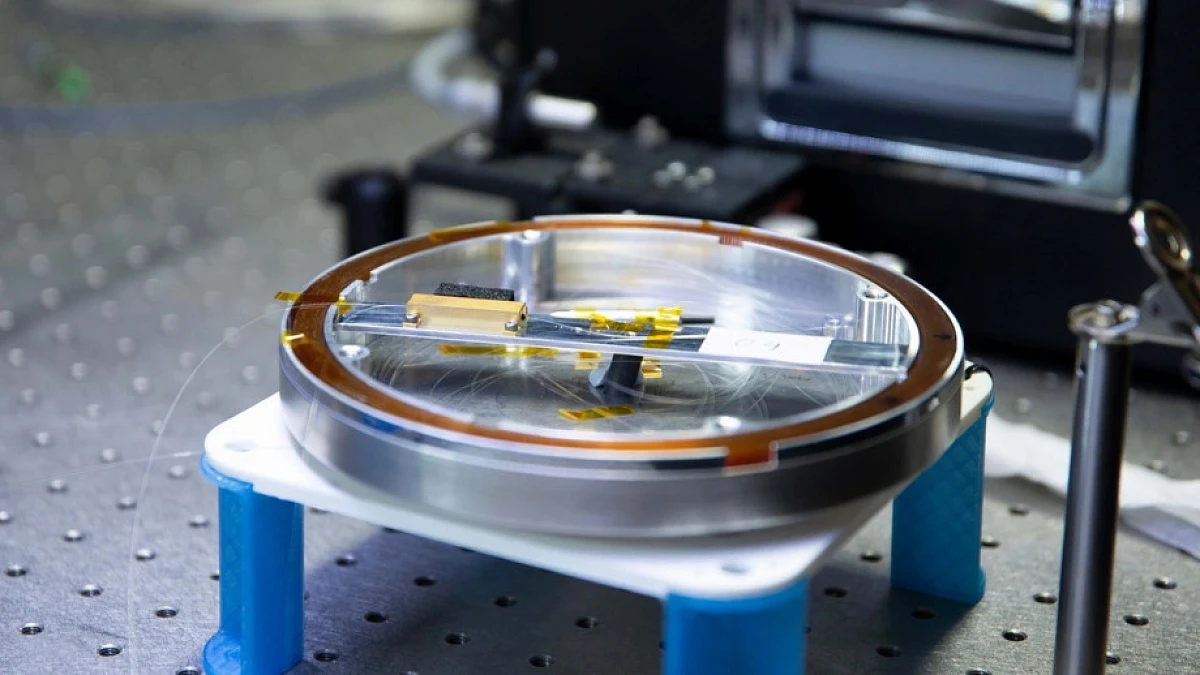
Members of Liquid Instruments’ founding team. From left to right:
Daniel Shaddock, CEO
Ben Coughlan, Chief Software Architect (ANU EngineeringStudent not associated with OzGrav or GW)
Daaf Rabeling, Chief of Hardware (ANU PhD GW Candidate)
Tarquin Ralph, Director (ANU PhD GW graduate)
Tim Lam, Chief Technology Officer (ANU PhD GW graduate)
Danielle Wuchenich, Chief Strategy Officer (ANU PhD GW graduate)

Next-gen navigation technology in a new $8.7 million project

Australian researchers and industry partners are joining forces to develop, design and manufacture the next-generation of optical gyroscopes for high-precision autonomous navigation in a new $8.7 million project.

The rapid and transformative development of autonomous vehicles in recent years has seen numerous technological breakthroughs. The deployment of ultra high-performance gyroscopes can enhance their performance in terms of safety and guidance.

The use of ultra high-performance gyroscopes can already be found in a wide range of industries including infrastructure management, mining, space sciences, agriculture, and defence. The new project is led by navigation systems manufacturer Advanced Navigation, with research partners The Australian National University (ANU), RMIT University, and commercial partner Corridor Insights. It will develop a new standard for optical gyroscopes, improving precision while reducing cost and size.

OzGrav Associate Investigator Jong Chow from ANU stated that the collaboration is a chance to bring together expertise from around the country: “We have such a broad range of photonics expertise in Australia. This project brings it together, creating a nexus between universities, research and education, industry and government.” The project has been supported through a $2.8 million Cooperative Research Centre Projects (CRCP) grant to Advanced Navigation.

Chris Shaw, CEO of Advanced Navigation, said the project would translate ground-breaking foundational research at universities to commercialisation, demonstrating Australia’s capability across the advanced manufacturing pipeline.

“This project will establish Australia as a leading manufacturer of high-performance, cost-effective navigation solutions,” Mr Shaw said.

At the core of this endeavour is technology developed at the ANU Centre for Gravitational astrophysics, OzGrav and Department of Quantum Science. The technique, ‘digital interferometry’, combines advanced signal processing with precision optics to create ultra-high-resolution measurements using light.

ANU researcher Chathura Bandutunga said: “We use digital signal processing to encode the lightwaves we use for our measurement. This encoding allows us to enhance the sensitivity of our instruments to rotation.”

While initially developed for measuring gravitational waves in spaceborne gravitational-wave detectors, the ANU team has adapted the technology to find a second home in optical gyroscopes.

In parallel, researchers at RMIT’s Integrated Photonics and Applications Centre (InPAC) are undertaking leading research in creating photonic chips – miniaturised optical components, enabling large experiments to be put into a much smaller package.

“The clever signal processing developed at ANU allows us to tell apart tiny signals from noise, and our photonic chip technology enables all that functionality to fit on a chip the size of a fingernail,” Distinguished Professor Arnan Mitchell from RMIT said.

“By compressing the light detection technology onto a photonic chip we can shrink ultra high-performance gyroscopes from the size of a bread box to the size of a coffee cup.”

Taking these research ideas through to the field, commercial partner Corridor Insights will pilot the next-generation of optical gyroscope in autonomous infrastructure management, looking for early detection of defects and faults in Australia’s rail network.

ANU invention aims to get driverless cars on the road

An invention developed at labs at the Australian National University could transform the way driverless cars safely navigate our streets.

Physicists at the ANU have set up a company to commercialise their work. They believe their idea will dramatically bring down the cost of “autonomous vehicles”, and so make a mass market much more reachable.

ANU physicist Chathura Bandutunga said the company he and his colleagues have formed, Forge Photonics, has received serious interest from two car companies.

The essence of their idea is that driverless cars need very exact systems of navigation. They need to be able to “see” exactly where they are in relation to other objects – including pedestrians and other cars on the road. But the equipment to do that at the moment is very expensive.

Dr Bandutunga went back to the basics of the machinery -particularly a gyroscope – and redesigned it from scratch. He said that the result was a gyroscope which was very accurate but a fraction of the cost of existing ones.

Gyroscopes are already used in submarines and aircraft to show the exact position of the vessel or plane on the Earth – but they are very expensive. Dr Bandutunga believes the ANU gyroscope can do the job at an affordable price – and that would make driverless vehicles much more commercially viable.

The way ideas which come from the publicly-funded ANU are turned into money-making ventures involves attracting big money from outside investors. The usual deal is that the investors get a cut of any profits and some also goes back to the ANU.

In this case, two groups are backing the commercialisation of the ANU idea: venture capitalists IP Group and superannuation fundHostplus.

The federal government has also put $200,000 into the project to help it become commercial.

“Self-driving cars need to know where they are, otherwise they can crash and cause damage, injuries and death,” IP Group head Eeshan Kulkarni said.

“Current navigation technology at a level that provides the desired degree of safety is uneconomical, and the solution developed by theForge team can unlock the potential for widespread adoption.”

The terms of the deal – who gets what money if it’s profitable – are being kept secret.

But the ANU was pleased with the deal linking its publicly-funded work with outside companies.

“I’m delighted that Forge Photonics is embarking on this collaboration with IP Group and Hostplus,” the ANU’s deputy vice-chancellor Lachlan Blackhall said.

“This partnership highlights the critical role of fundamental research in addressing important industry challenges and positions us at the forefront of the global autonomous vehicle technology boom. We look forward to the continued success and impact ofForge Photonics over the years ahead.”

Article written by Steve Evans, a reporter for The Canberra Times. Access the article here: https://www.canberratimes.com.au/story/8744669/anus-new-affordable-tech-boosts-driverless-car-safety/

CREDIT: Chathura Bandutunga. Picture supplied by ANU

Pulsed Tm-fiber (Thulium) lasers for weed killing

Traditional weed control using herbicides is becoming increasingly problematic. Pestilent weeds reduce productivity in agriculture by damaging crops and reducing yield in a multi-billion-dollar farming industry. Current methods of weed control resort to the use of herbicides and toxic substances that persist in soil and are detrimental to humans and wildlife.

The use of CO2 lasers to prevent or delay weed growth has been demonstrated as an eco-friendly and economically viable alternative. The concept has already been proven with CO2 lasers mounted on land-based vehicles for short-row crops like vegetables. In 2022 OzGrav awarded a $25,000 Seed grant to a team led by OzGrav student Zachary Holmes, to investigate extending laser weed-killing capabilities to taller field crops such as grains and grasses, orchards, or vineyards, which has not yet been demonstrated. The proposed system is readily adaptable to replace other pesticides and has greater potential for mounting on a drone to improve speed and non-invasiveness.

The cost-effectiveness of laser-based weed killing depends critically on the laser parameters and SWAP (Size, Weight, and Power) performance. Laser weed killing exploits the very high water content and very low reflectance in the 1.90-1.94 µm band. This project will use a Thulium (Tm) fiber laser to determine the optimum laser parameters (wavelength, beam diameter, average power, pulse width) for weed killing.

The laser weed-killing demonstration is also a pathway towards translating research into single-frequency laser diode-seeded Tm-fiber amplifier sources into a commercialisable laser weed-killing unit for mounting on an autonomous vehicle. The project is in collaboration with the Weed Science Research Group in the School of Agriculture, Food & Wine at the University of Adelaide (UoA).

We will configure, test and optimise the laser system, and then install it at Waite Research Institute. Our team includes ARC Centre of Excellence for Gravitational Wave Discovery (OzGrav) experts in fiber laser development:

  • Zac Holmes, PhD student in the field of laser source design and stabilisation with first-class honours in mechanical engineering, who has designed and successfully demonstrated a seed source and Tm:fiber amplifier concept for future adaptation;
  • Dr Sebastian Ng, co-chair of the OzGrav Quantum Program with extensive experience in fiber laser development, and space applications team leader at QuantX Labs, translating terrestrial laser and quantum technologies for satellite payloads;
  • Prof Peter Veitch, Head of School of Physical Sciences and OzGrav Adelaide node leader with a proven track record of coordinating and undertaking research in laser systems for environmental, industrial, and defence applications; and
  • Emeritus Prof Jesper Munch, a longstanding member of the Australian optics community with invaluable contributions to the fields of high-power lasers, nonlinear optics, and gravitational wave detection.

The team also includes University of Adelaide School of Agriculture, Food & Wine – experts in weed control research:

  • Dr Andrew Hennesey, Image and Data Analyst specialising in the classification of hyperspectral vegetation datasets;
  • Dr Jenna Malone, a senior postdoctoral fellow in the Weed Science Research Group researching the understanding and management of herbicide-resistant weeds;
  • Dr Darren Plett, the Technology and Development Lead at the Plant Accelerator researching phenotyping technologies to improve agricultural crop productivity; and
  • Prof Timothy Cavagnaro, an expert in management of soil ecological processes with a great degree of experience in cross-disciplinary technologies and techniques.

The team proposes to use a Tm-fiber laser source to research the optimum parameters (wavelength, beam diameter, average power, pulse width) for laser weed killing of flat-leaf weeds. Our proposed demonstration with a Tm-fiber laser source is also a pathway toward mounting onto an autonomous vehicle for field testing.

The vehicle is equipped with Artificial Intelligence (AI) weed detection and locating capabilities, including a scanner to direct the pulsed laser beam(s) towards the target weed. A likely field test of the system will be laser weed killing in a vineyard through collaboration with the Australian Wine Research Institute. Further collaboration will be initiated with autonomous vehicle experts in the UoA’s School of Mechanical Engineering and AI experts at the UoA and Australian Institute of Machine Learning (AIML), who are currently developing AI detection systems for other applications. The team will pursue further funding to progress this study beyond the proof-of-concept phase.

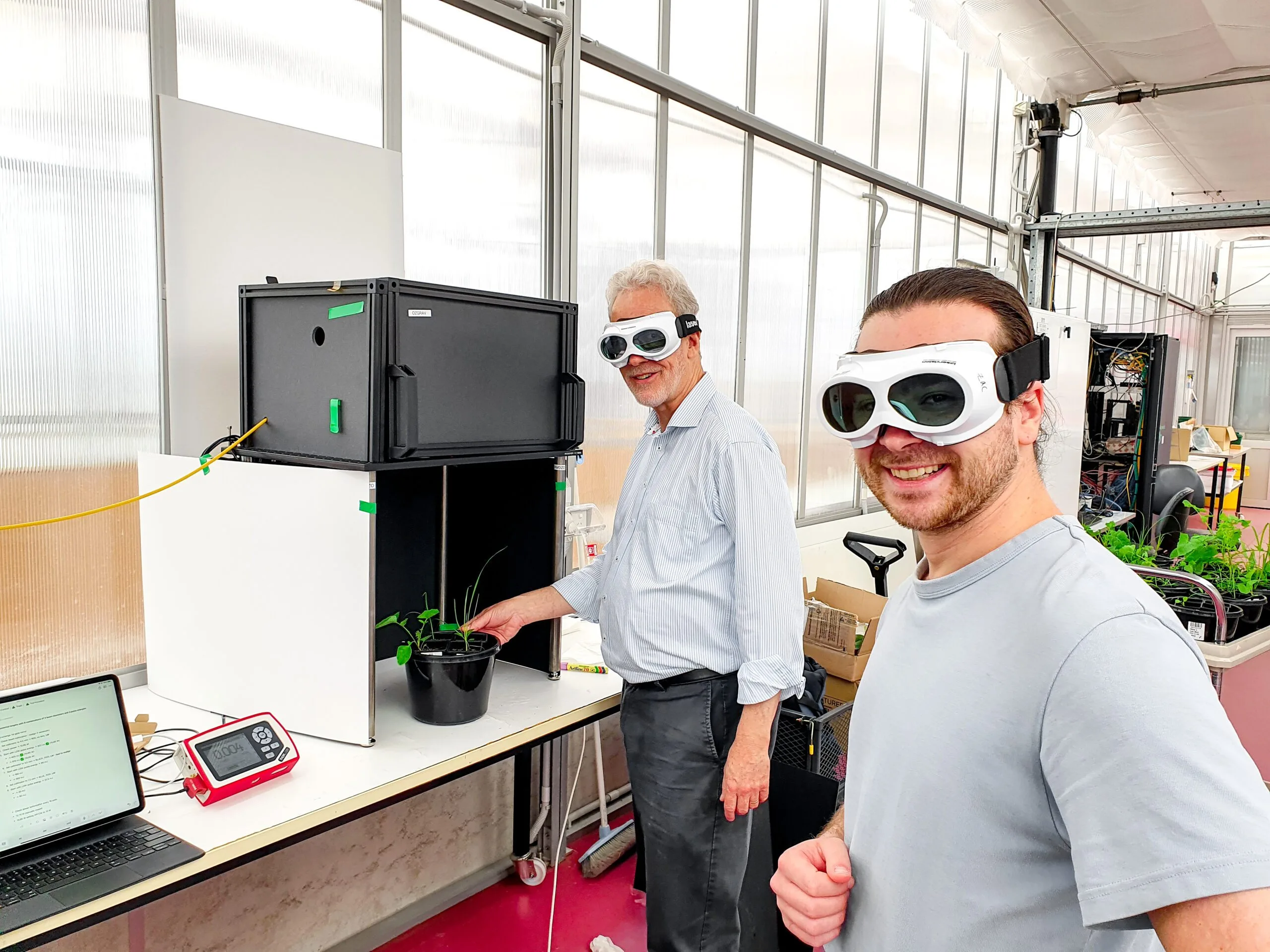
Image: Prof Peter Veitch (L) and PhD student Zac Holmes (R ) at University of Adelaide testing lasers on weeds. Credit: Zac Holmes, OzGrav-Adelaide